Germany, 1944–1948
Refuge in Windsheim, Virve’s death, and Elmar Koik’s hospitals and refugee status.
Leoke familyRefuge in Windsheim
From Gotenhafen the family went on to the small Franconian town of Windsheim (today Bad Windsheim) in Bavaria. Their residence notification was filed on 26 September 1944. Stateless-alien passports followed on 27 October.1 They lodged in rooms rented from local families rather than in a camp. The registration card gives 22 September both for entry through Gotenhafen and for the first Windsheim lodging. The repeated date does not establish that they reached Windsheim on the day they arrived at Gotenhafen.
| Date recorded | Address in Windsheim |
|---|---|
| 22 Sep 1944 | Weinmarkt 434, with the Götz family |
| 2 Nov 1944 | Äußere Ringstraße 568½ |
| 14 Feb 1946 | Brenkgasse 335, with the Koch family |
| 6 Jun 1947 | House no. 602 (street name uncertain), with the Hönig family |
| Not dated | Oberntiefer(?) Straße 562, on the family’s Estonian exile register cards2 |
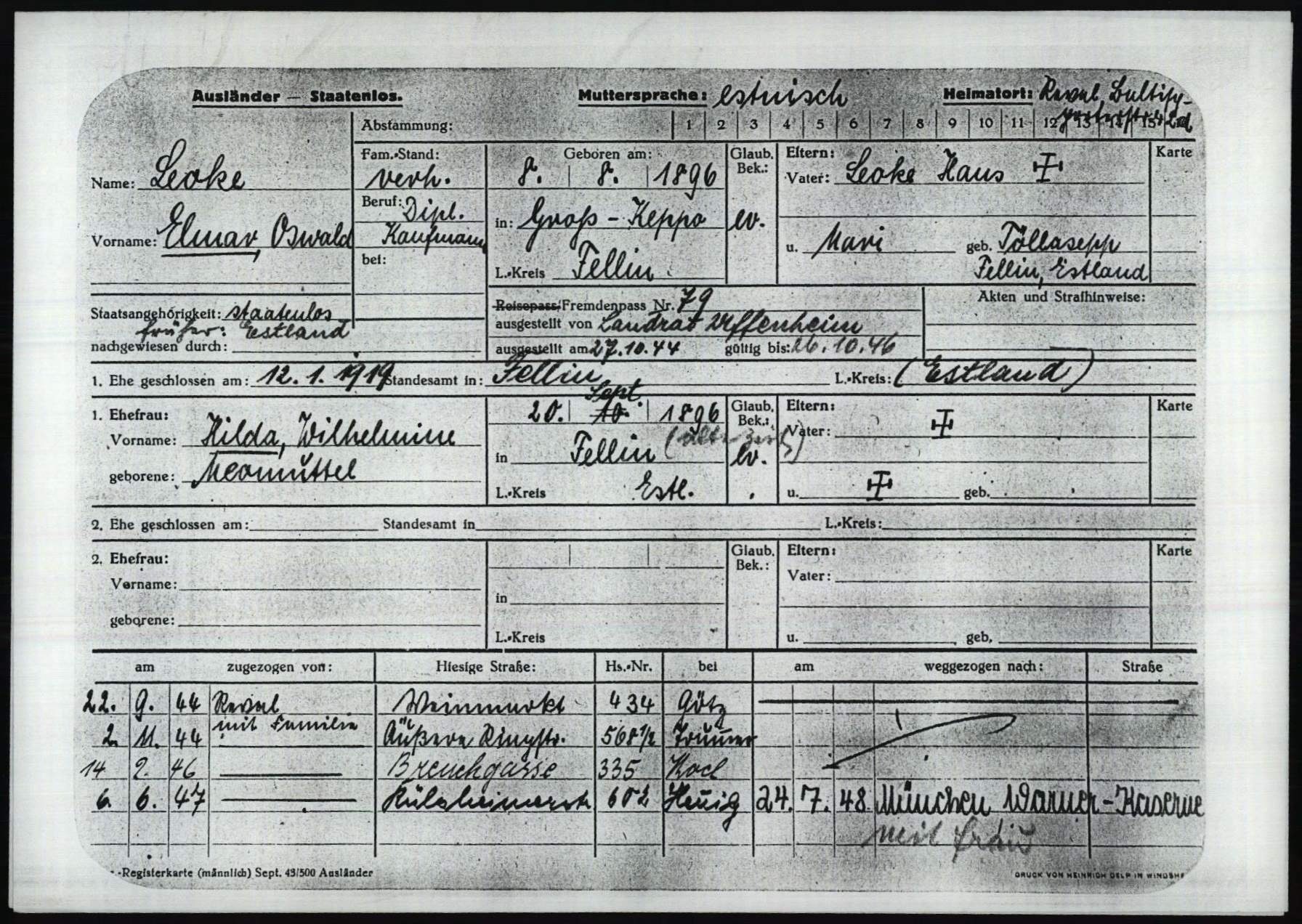
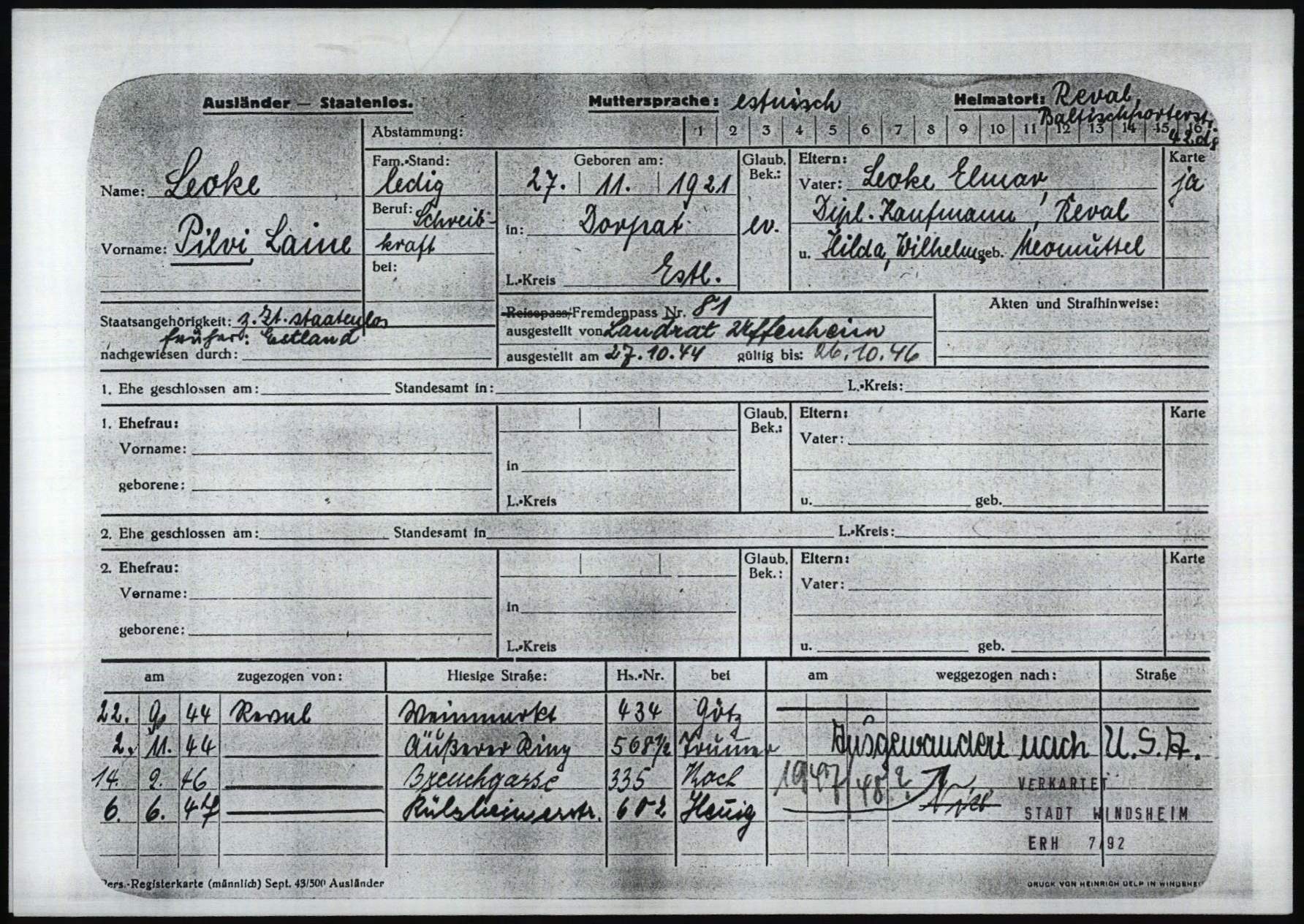
Pilvi worked in Windsheim as a typist and was registered with the local labor office in February 1945. Hilda was employed by the district administration (Landrat Uffenheim) from October 1945 to April 1947. According to the Album Academicum, Elmar Oswald was manager of a brewery in Windsheim.
Leoke familyVirve
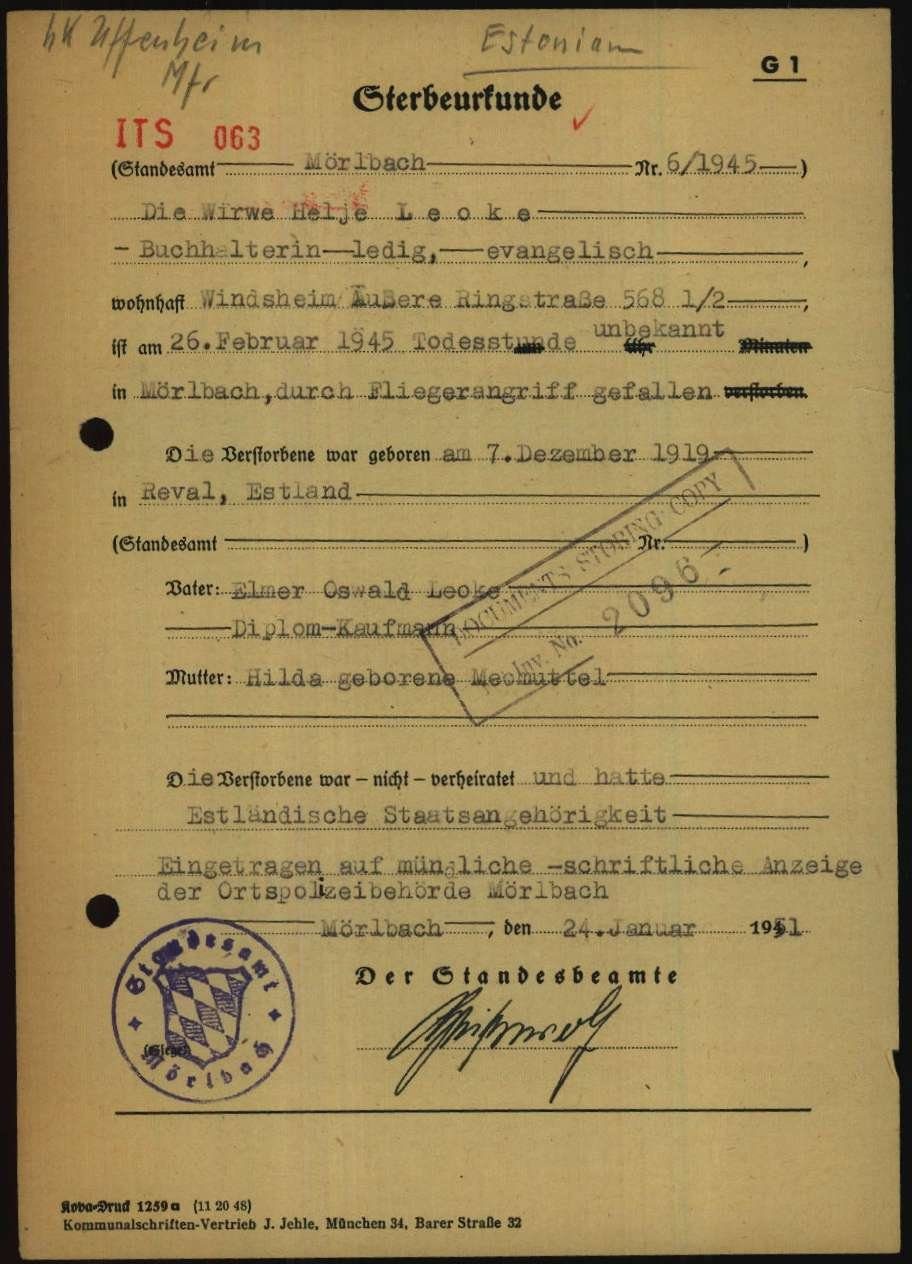
Five months after the family arrived in Germany, Virve was killed in an Allied air attack. She died on 26 February 1945 at Mörlbach, a village about 10 km southwest of Windsheim (now part of Gallmersgarten), aged 25. She was living with her parents at Äußere Ringstraße 568½.3
She was buried in Windsheim cemetery, in the old section, grave no. 110a, according to a list compiled in January 1951. Whether her grave survives, and in what condition, is not yet known.
Family memory holds that Virve was killed in an attack on a train.4 Local accounts collected in Königshofen 1945, a history of a Franconian village whose pastor died in the attack, describe such an event. On 26 February 1945 low-flying aircraft fired on a crowded passenger train near Mörlbach for almost half an hour, while passengers took cover under the carriages and beside the track. Pastor Hermann Bauernfeind of Königshofen, on his way to visit his daughter in Würzburg, was killed. The book’s editor cites an account by the local pastor, Dannhaimer: the train was carrying soldiers, Soviet prisoners of war and civilians, and after the attack a carriage, two field barns and a house annex were burning, with the dead and wounded lying around the train.5
None of these accounts names Virve or gives a named passenger’s eyewitness account, and the surviving versions of two of them were transcribed in 1954. They give the same date and place as Virve’s death certificate, and with the family’s recollection of a train attack, they make the Mörlbach attack the probable circumstance of her death. Her presence on the train rests on family memory rather than on a document. The US Army Air Forces chronology records XIX Tactical Air Command armed reconnaissance in the Aschaffenburg–Würzburg area that day; it provides regional context, not identification of the aircraft that attacked the train.6
Koik familyElmar Koik: hospitals and refugee status
Elmar spent more than a year in military hospitals at Pilsen, Marienbad and Regensburg. American forces reached Marienbad in May 1945. In October, after recovering, he walked to the displaced-persons (DP) camp at Regensburg.
By 1946 he was at Geislingen DP camp, administered by Team 190 of the United Nations Relief and Rehabilitation Administration (UNRRA). In September a US Army screening board refused him DP status and he was evicted. He moved into a private room in nearby Eislingen.
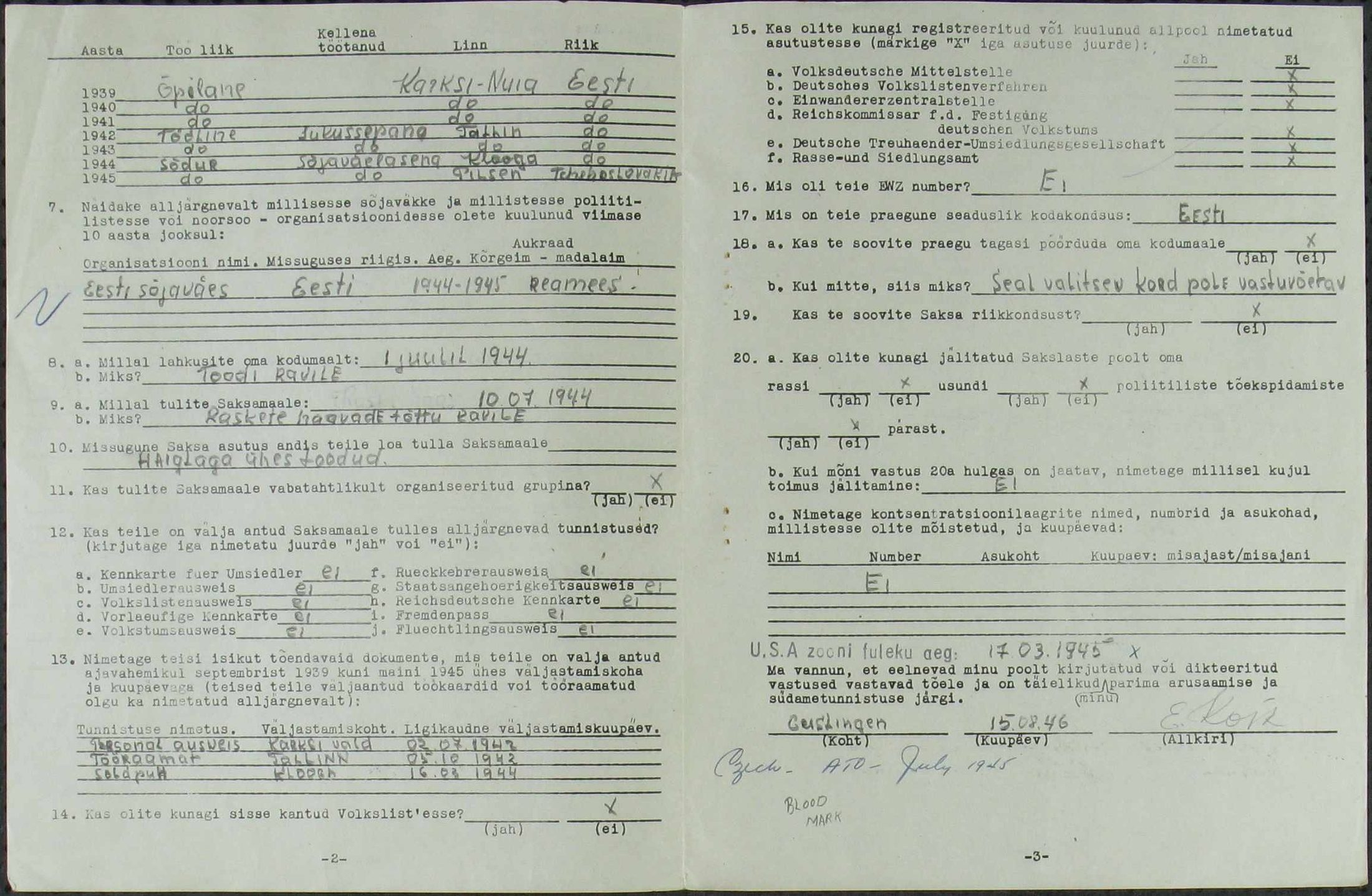
The 1946 decision on DP status. Elmar described his unit as an Estonian military drivers’ school. The US screening board recorded him as a grenadier in an Estonian division and gave “SS” as the reason for refusing DP status. The division number is unclear in the record. The board also noted that he had been “mobilized against will”, had remained in hospital during his stay in Germany, and was “not believed to be a security suspect”. A later compilation of Estonians in Finnish and German service lists him as a soldier in the field battalion of the 3rd Estonian Volunteer Brigade; how that listing relates to his own account and to the board’s has not been established.7
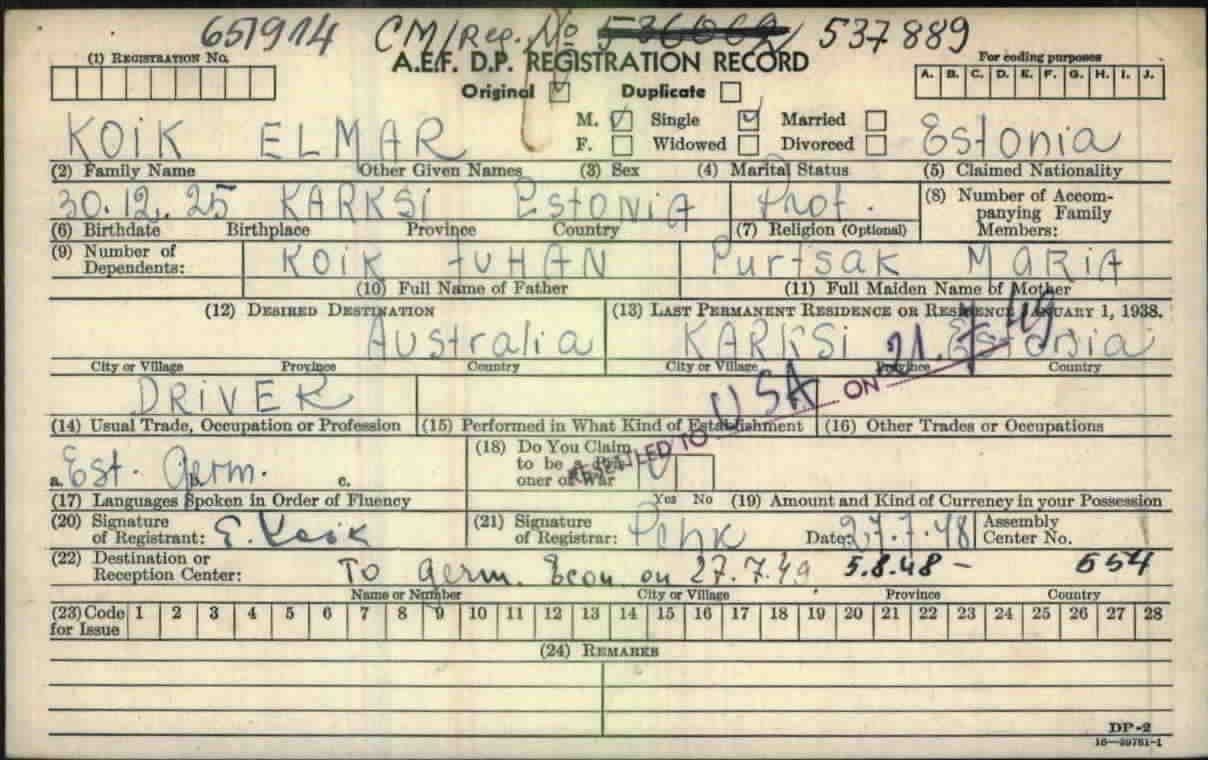
In 1947–1948 he worked as a civilian guard for the US Army, first at Mannheim and then with the 501st Engineers at Wolfgang near Hanau. His case was referred to the Military Appeal Board on 28 June 1947. A separate DP registration record is dated 27 July 1948, but no final appeal decision has been found.8
Notes
-
Arolsen Archives, Windsheim residence notification and alien-passport records: notification filed 26 September 1944; passports issued 27 October, nos. 79 (Elmar Oswald), 80 (Hilda) and 81 (Pilvi). ↩
-
Estonian National Archives, exile register cards, ERA.4942.4.8, images 1873 (Elmar Oswald), 1874 (Hilda) and 1877 (Pilvi). The cards are not dated, and the street name is tentatively read. Elmar Oswald’s card also notes the Warner-Kaserne camp in Munich in April 1948, earlier than the move of 24 July 1948 recorded in the Arolsen papers; the discrepancy is unresolved. ↩
-
Mörlbach death register no. 6/1945; surviving certificate issued 24 January 1951 for postwar tracing documentation. Its issue date does not establish when the family learned of Virve’s death. The certificate records the hour as unknown and describes her as single and Lutheran. ↩
-
Family recollection, confirmed by relatives in October 2026. Who first told the story, and from whom they heard it, is not yet recorded. ↩
-
Michael Weber (ed.), Königshofen 1945 (Norderstedt: Books on Demand, 2020), ePub without stable page numbers; accessible preview. Three passages describe the attack. (1) Hans Greifenstein, “Die letzten Tage des 2. Weltkrieges in Königshofen,” second paragraph, opening “Der Berichterstatter war am Sonntag, den 18. März 1945…”; the heading identifies a transcription made by Pastor Erwin Günther in July 1954, which is not necessarily the date of original composition. Greifenstein, who reached Königshofen in March 1945, does not claim to have witnessed the attack, and he dates it as three days after the Ansbach raid of 23 February rather than by calendar date. (2) Berta Bauernfeind, the pastor’s widow, “Bericht über die Amtszeit von Pfarrer Hermann Bauernfeind 1936–1945,” transcribed by Pastor Günther on 14 July 1954, which gives 26 February 1945. (3) The editor’s biographical note on Hermann Bauernfeind, which also gives 26 February and reports Pastor Dannhaimer’s description of the scene; it calls him “der dortige Pfarrer” (the pastor there) without naming his parish. These are local accounts, not testimony by named passengers. The book places the attack at “Mörlbach bei Steinbach”. No Steinbach next to Mörlbach has been identified. Steinach, which like Mörlbach is now part of the municipality of Gallmersgarten, is the junction where the branch line from Bad Windsheim meets the Treuchtlingen–Würzburg line, the route a traveler to Würzburg would take; Steinach may be meant, but this is not confirmed. The German extracts and translations are kept with the research files. ↩
-
Kit C. Carter and Robert Mueller, U.S. Army Air Forces in World War II: Combat Chronology, 1941–1945 (Center for Air Force History, 1991), entry “2/26/45 Ninth AF,” PDF page 633 of 743. This is a high-level operational summary, not an individual mission report identifying the aircraft or unit responsible for Virve’s death. ↩
-
WWII refugees database (2024.wwii-refugees.ee), entry for Elmar-Heinrich Koik, consulted 19 October 2026, quoting lists of Estonians in Finnish and German forces, 1940–1945, which cite Estonian National Archives files ERA.R-64, ERA.R-67.2.7 and 10, and ERA.R-165.1.5, 87 and 112: “In the German army, soldier, 3. Estonian Volunteer Brigade Field-Battalion.” The entry reads “KOIK, Elmar, Juhan, m, s. 30.12.1925 Viljandimaa, Karksi v.”, matching his birth date, father’s name and parish; the underlying personnel files have not been examined. His exile register card (ERA.4942.4.6, image 2125) describes him as a driver from Tallinn; the card reads “30.12.25”, although the database’s index line for it gives 31 December 1929. ↩
-
Arolsen Archives, Elmar Koik’s 1946–1947 questionnaires and screening papers, 1948 registration and IRO emigration records; US National Archives, New Orleans arrival card, 5 September 1949. Statements about mobilization, unit and wounding are attributed to his later accounts; the screening board’s account is distinguished in the text. ↩