Leaving Estonia, 1944
The occupations, Elmar Koik’s mobilization and wounding, and the evacuation of Tallinn in September 1944.
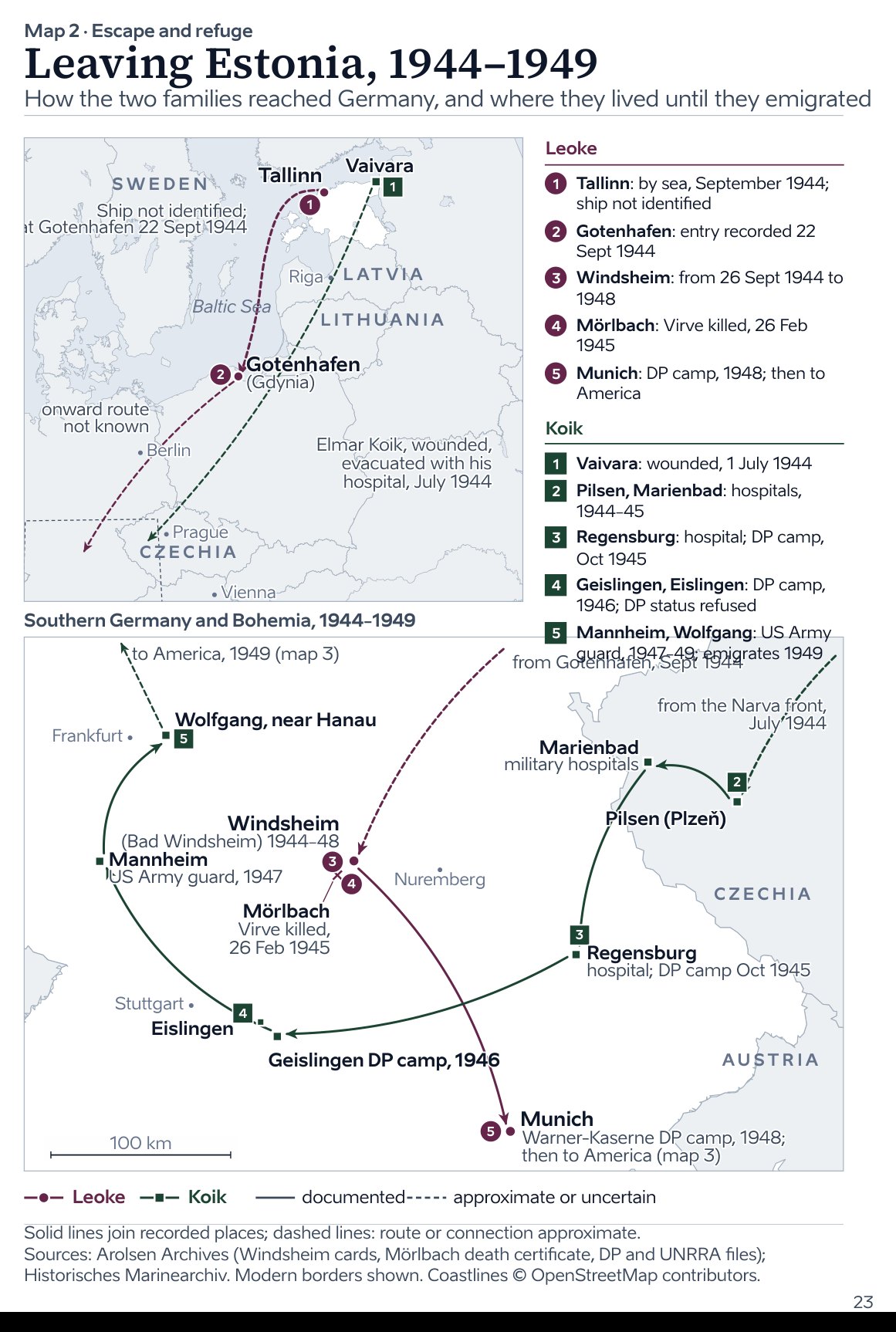
Estonia was occupied by the Soviet Union in June 1940, by Nazi Germany in 1941, and again by Soviet forces as the German armies withdrew in 1944.1 Elmar Koik left with his hospital after being wounded in July. The Leokes departed during the September evacuation of Tallinn.
Koik familyElmar Koik: mobilization and evacuation
By his own account, Elmar was mobilized at 18 on 2 February 1944 by the Estonian Self-Administration under German occupation. His military paybook was issued at Klooga on 16 March, and he described his unit as an Estonian military drivers’ school.
On 1 July he was badly wounded at Vaivara, on the Narva front. His later questionnaire records that he arrived in Germany with his hospital on 10 July. His departure from Estonia was an evacuation for medical treatment, months before the Leokes’ September journey.2
Leoke familyEscape from Estonia, September 1944
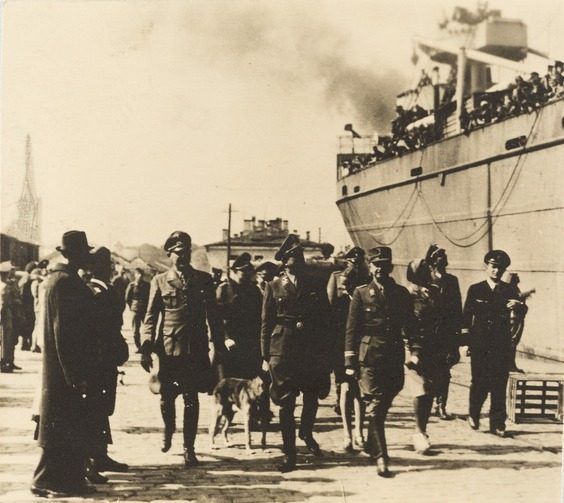
In mid-September 1944 the German front in Estonia collapsed, and between 17 and 22 September the German navy evacuated some 50,000 soldiers and more than 27,000 civilians from Tallinn. The main departures were on 20 and 21 September, as Soviet forces closed on the city; Red Army tanks entered Tallinn on the 22nd.
Elmar Oswald’s German registration card records the family of four entering Germany through Gotenhafen (now Gdynia, Poland) on 22 September 1944. The Historisches Marinearchiv database lists three ships arriving there from Tallinn that day: Wartheland, Minden and Hansa (formerly Glengarry). Any of these may have carried the Leokes, but their ship has not been identified.3
In Soviet-occupied Estonia, the family’s departure was recorded a year later. On 12 October 1945 the Tallinn First State Notary Office declared Elmar Oswald, Hilda, Virve and Pilvi missing since 22 September 1944, the day Soviet forces entered Tallinn, and gave their last address as Paldiski maantee 42. The certificates were issued to “Mari Jaani t. Leoke” (Mari Leoke, daughter of Jaan), Elmar Oswald’s mother, who had stayed in Estonia. The declaration was a legal classification of their absence; it does not show what Mari knew of their fate. By then Virve had been dead for more than seven months.4
Notes
-
Estonian Ministry of Foreign Affairs, “75 years since the end of the Second World War”. ↩
-
Arolsen Archives, Elmar Koik’s 1946–1947 questionnaires and screening papers, 1948 registration and IRO emigration records; US National Archives, New Orleans arrival card, 5 September 1949. Statements about mobilization, unit and wounding are attributed to his later accounts; the screening board’s account is distinguished in the text. ↩
-
Historisches Marinearchiv, Ostseeflucht voyage database, entries for Wartheland, Minden and Hansa, arrivals at Gotenhafen on 22 September 1944. The database cites the Gotenhafen naval command war diary for Wartheland and Hansa (R.4041, scan 686). These ship movements do not identify the family’s vessel. ↩
-
Eesti NSV Teataja Lisa 1945, no. 2 (11 December 1945), p. 9, entries XV–XVIII (DIGAR 232025). Mari’s baptism names her father as Jaan, which identifies her as the “Mari Jaani t. Leoke” of the notice; her son Hans’s biography of about 1923 likewise calls her “Mari Jaani t. Tõllasepp”. ↩