Juhan’s parents and the earlier Koiks
Juhan’s parents came from Vana-Kariste and Õisu, married in Paistu and later moved to Halliste:
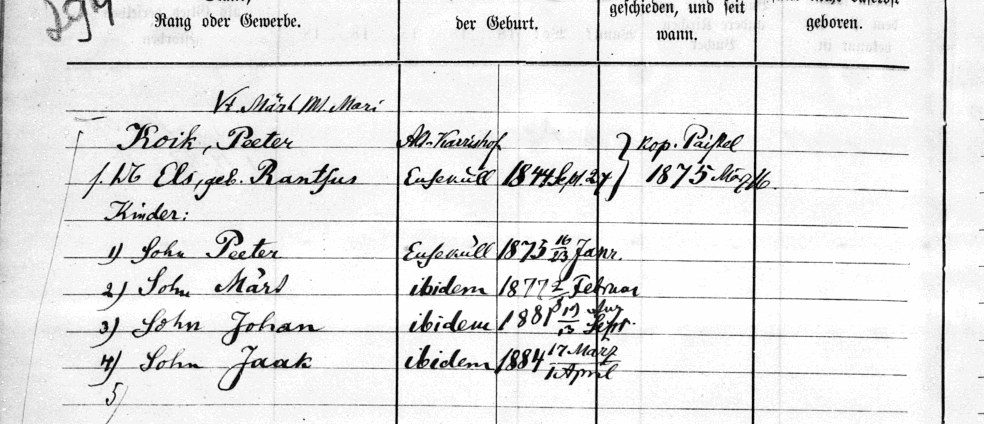
- Peeter Koik was born at Sönni farm on the Vana-Kariste estate in Halliste parish on 7 February 1849 O.S., the son of Märt Koik and Mari née Riig.1
- Els was born at Õisu (Euseküll) on 24 September 1844 O.S., the daughter of Henn and Ann Rantsus. The household book’s Ranthus is a variant spelling of the same name.
- They married at Paistu on 16 March 1875 O.S. Their sons were all born at Õisu: Peeter, born on 16 January 1875 and baptized as Peter Rantsus, under his mother’s surname, two months before the wedding; Hans (2 February 1877), whose later life is unknown; Märt (probably 12 April 1878, from the household book); Johan, born 19 August 1881 (Old Style) and baptized 13 September; and Jaak (17 March 1884).
- A parish certificate dated 1 September 1887 records the family’s move to Halliste, which explains why Juhan was confirmed and married there.
- Peeter died on the Vana-Kariste estate on 6 January 1896 O.S., aged 46, of consumption, when Juhan was fourteen. He was then a lodger on Ilbaku farm.
- The same books list Hans Koik (22 January 1846 – 22 June 1903), Peeter’s elder brother: Juhan’s uncle.
Peeter’s parents, Märt Koik and Marri Riig, had married at Halliste on 22 March 1845; Marri came from Lobbine farm on the same estate. Märt was the youngest son of Hans Koik and Kert, Endrik’s daughter, of Kama Peter farm. In 1811, before peasants on the estate had surnames, Hans was a farmhand there, aged 32. The family name first appears in a list of peasants released from serfdom, handed in on 18 January 1825, which names “Hans Koik”, 44, and his wife “Kert Koik”. The list does not say why the name was chosen. Koik is an old Estonian personal name, and the surname probably comes from it; Koiksaare, a neighboring farm once suggested as its source, was home to other families. Märt and Marri moved to Õisu in 1871. Märt died there in 1874, and Marri in 1885.2 Appendix C gives the earlier generations of Peeter’s and Els’s families.
The household of Juhan Koik
The Karksi household register (personaalraamat) for 1904–1932 lists the whole family together under “Karkus”, the Karksi manor district:
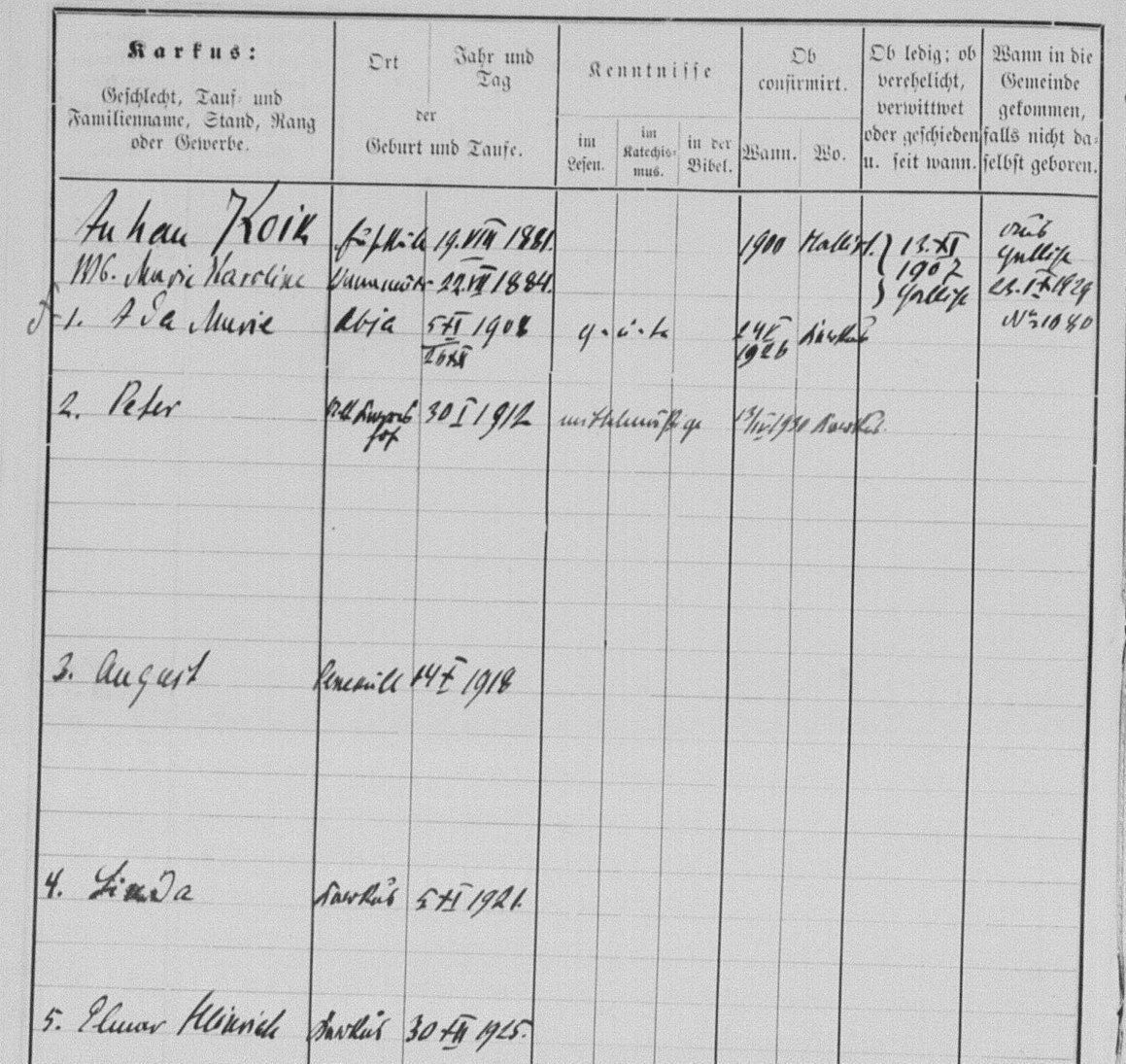
- Juhan Koik, born 19 August 1881 (Old Style). Confirmed in 1900, apparently in Halliste; married in Halliste church on 18 November 1907 (Old Style), when he was a lodger at Paloja farm in Abja.3
- Marie Karoline, his wife, born 22 July 1884 (Old Style) at Friedrichsheim in Halliste parish, the daughter of Peter Purtsak and Anno; a margin note in the register also names her father. In 1907 she was a maid on the Kaubi (Neu-Bornhusen) estate.
- Ida Marie, born 5 November 1908 at Palua farm in Abja. Confirmed in Karksi in 1926; moved to Halliste on 10 December 1929 and married Johan Põder of Vana-Kariste there on 22 December.
- Peter, born 30 January 1912.
- August, born 14 October 1918.
- Linda, born 5 June 1921 (month uncertain) in Karksi.
- Elmar Heinrich, born 30 December 1925 in Karksi.
A note records the family’s membership being transferred from Halliste congregation.
A sixth child, Martin, born on 7 May 1910 at Lesmendi farm on the Vana-Kariste estate, is not on this page. He drowned on 21 July 1919, aged nine, and was buried at Halliste; his death entry gives the place as Karksi manor, though that reading is uncertain.4
In November 1920, Juhan was recorded as a married father of three, registered in Vana-Kariste and engaged in agricultural work. His military papers record earlier service as a private from 1915 to 1918. On 13 November 1920, the Pärnu County military commission accepted him for service and released him into the reserve under demobilization provisions.5
A Karksi residents’ list for 1924–1927 records the household living at the manor (“Mõisa”), previously registered at Vana-Kariste. Entered beside them is Els, Peeter’s widow, born in 1844: Juhan’s mother, who died at the manor on 9 March 1926, aged 81, and was buried in the new cemetery at Karksi. Juhan and Marie were both still living in December 1929, when Ida married; no later record of them has yet been found.6
Life on the Karksi manor estate
Karksi manor’s center lay about two kilometers northeast of Karksi castle, a fortress of the Livonian Order whose ruins date from the 14th–16th centuries. The parish church stands on part of the castle site, in what is now Karksi-Nuia; the manor buildings are in Karksi village.
Before 1917 the parish lay in the Pärnu district of Livonia, a province of the Russian Empire, so the old records say “Karkus, Kreis Pernau”. After the Great Northern War the Russian crown granted General Georg Reinhold von Lieven the use of the manor, and through the 18th and 19th centuries it belonged to Baltic German noble families, the von Lievens and later the von Duntens. The Lievens’ eighteenth-century Baroque chapel still stands near the ruins.
The wooden manor house is gone, but the granary (1840), the steward’s house (now the village library and museum), the chief forester’s house and the forge survive, and Karksi Brewery operates on the former estate.
How a manor worked
When Juhan and Marie married in 1907, most of the land in what is now Estonia still belonged to a few hundred Baltic German noble families. Serfdom ended in Livonia in 1819, but emancipation did not give peasants ownership of the land. For decades, many owed labor on the manor’s fields as rent for their holdings. During the 1850s and 1860s, cash rents increasingly replaced labor obligations, and peasants could buy their farms. By 1900 many Mulgimaa farmers owned theirs. The manor’s own home farm and forests stayed with the baron.
Rural workers included hired hands on farms, cottagers, and manor workers: farmhands paid partly in grain, potatoes, milk and a room in a workers’ house, and craftsmen such as gardeners, smiths, foresters, coachmen and brewers. Juhan is entered as a laborer (tööline) living on “Karkus”, the manor district.
War and land reform
The War of Independence reached Karksi in January 1919. Estonian forces drove the Red Army from the manor and Nuia on 4–5 January. The date when the Koiks settled on the estate has not been established. Martin’s death entry may place the family at the manor by July 1919, but the reading is uncertain, and in November 1920 Juhan was still registered at Vana-Kariste. A fuller account and the battle map appear in Appendix B.
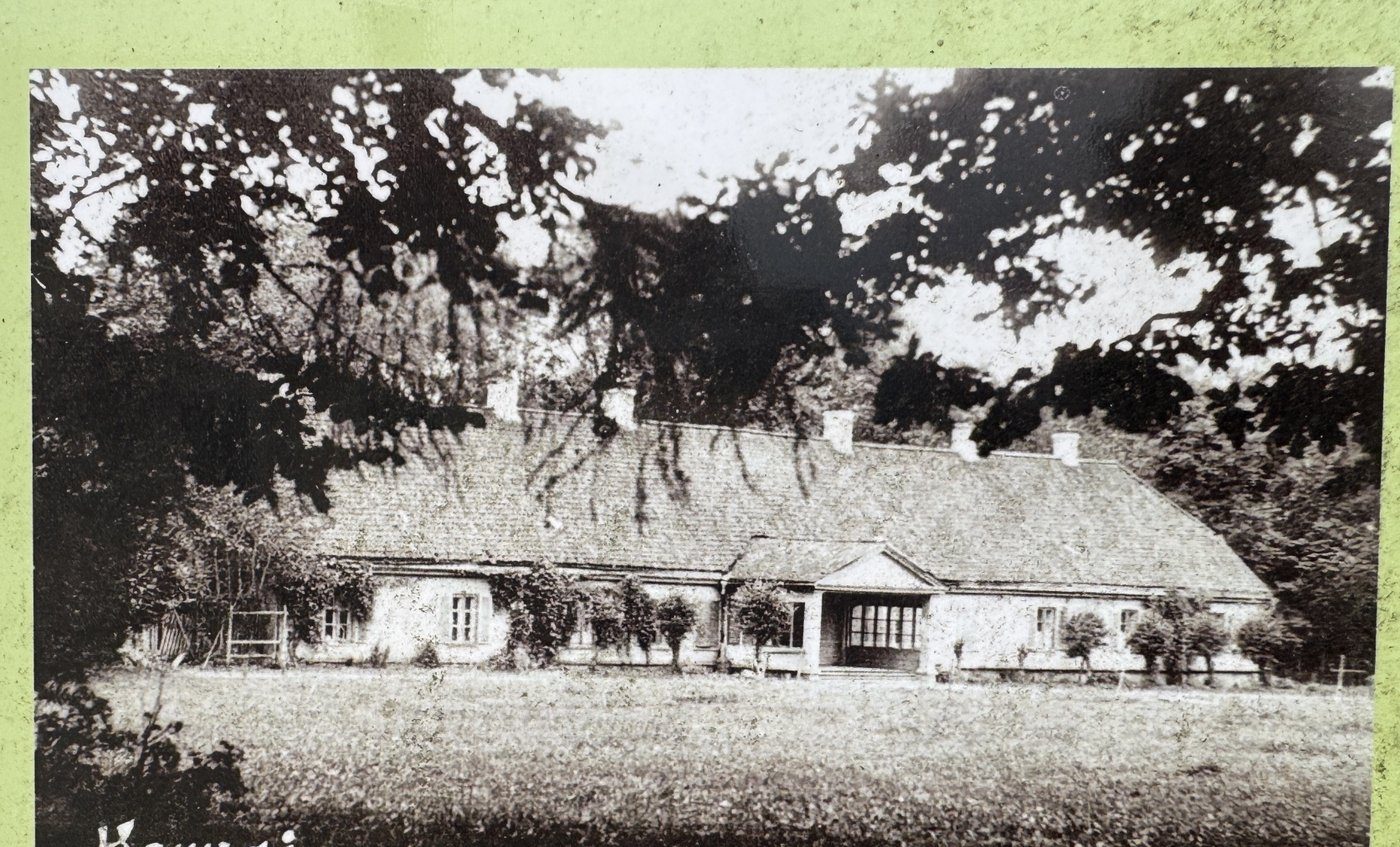
In October 1919, during the War of Independence, Estonia’s Land Reform Act took over almost every noble estate, around a thousand manors and more than half the country’s farmland. Compensation was addressed by later legislation in 1926. The land was cut into thousands of new smallholdings for landless people, with priority for war veterans, and the manor centers became schools, offices or state farms, or were left to decay. So when Elmar was born there in 1925, “Karksi manor” meant a former estate owned by the state, with the old manor center, workers’ houses and new smallholdings around it. Whether Juhan applied for or received a farm is not known. At Karksi, a board in the village records that the manor’s land was divided in 1920 into 54 settler holdings.
Elmar Koik’s birth and baptism
Elmar Heinrich Koik was born on 30 December 1925 and baptized on 5 April 1926 by Pastor Benedikt Masing, apparently at the family’s home on the manor. His parents are entered as Johann Koik and Marie née Purtsak. The entry, No. 58 in the Karksi Lutheran register of births for 1925, is handwritten in Estonian on a printed Russian form; a fuller transcription, including the godparents and uncertain surname readings, appears in Appendix C.
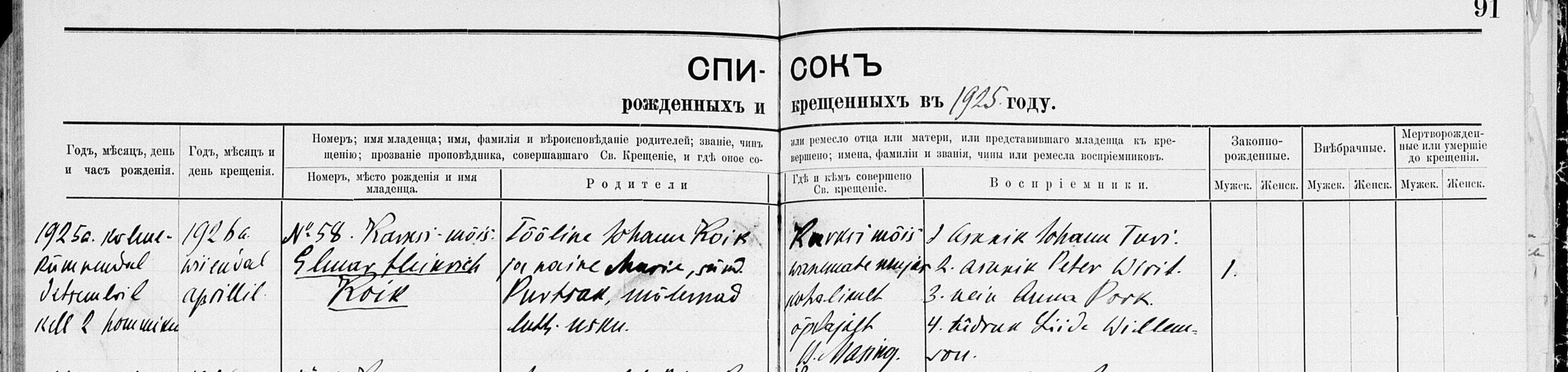
The register describes Juhan as a laborer but does not name his employer. Two godparents were gardeners; this does not establish that Juhan also worked in the manor gardens.
Elmar’s school and working years
Elmar attended elementary school in Karksi-Nuia for six years, from 1934 to 1940. In 1938 he joined the Estonian Scouts, the civilian Boy Scout movement. Scouting was banned after the Soviet occupation of 1940. His later questionnaire records work as a locksmith in Tallinn in 1942–1943; Karksi parish issued his identity card in July 1942.7
Notes
-
Birth: Vana-Kariste births list, EAA.1275.1.169, image 18; baptism, EELK Halliste congregation, births 1849, EAA.1275.1.117, image 10, No. 59 (13 February 1849). Els: EELK Paistu congregation, births 1844, EAA.1286.1.75, image 25, No. 285 (baptized 1 October). Marriage: Paistu, 1875, EAA.1286.1.358, image 49, No. 17, with banns on 2, 9 and 16 March; Peeter is a bachelor of Alt-Karrishof, Els a single woman of Kildi farm, Euseküll. The entry gives his age as 33, a clerical slip; he was 26. Sons: Paistu births 1875, EAA.1286.1.298, image 4, No. 29; 1877, EAA.1286.1.300, image 3, No. 22; 1881, EAA.1286.1.304, image 15, No. 162; 1884, EAA.1286.1.307, image 8, No. 93; Märt’s date from the Halliste household book, EAA.1275.1.546, image 70. Peeter’s death: EELK Halliste congregation, deaths 1896, EAA.1275.1.565, image 60, No. 1, “Alt-Karrishof Ilbaku lodger Peter Koik”, aged 46 years 10 months, buried 9 January. ↩
-
Marriage of Märt Koik and Marri Riig: EELK Halliste congregation, marriages 1845, EAA.1275.1.530, image 29, No. 12. Alt-Karrishof soul revisions: 1811, EAA.1865.3.171/4, image 16 (Kama Peter, with no surnames); 1826, EAA.1865.3.171/11, image 35; 1834, EAA.1865.3.172/4, image 27. Release-from-serfdom list of Alt-Karrishof, handed in 18 January 1825: Pärnu County 3rd parish court, EAA.931.1.22, image 15, under the farm “Kammapeter”, which held three households with three different surnames. On the old personal name Koik, which underlies place names such as Koigi (recorded as Koic in 1241 and Koicke in 1441), and on the farm names Koiksaare and Koigu: Institute of the Estonian Language, Eesti kohanimeraamat and the place-name database KNAB. Deaths: EELK Halliste congregation, deaths, EAA.1275.1.542, images 20 (1874, No. 95, at Euseküll, aged 53) and 103 (1885, No. 117, at Carlsberg, aged 65½). ↩
-
EELK Halliste congregation, marriages 1907, EAA.1275.1.563, image 240, No. 110, also in the short marriage list. The Karksi household register gives 13 November. Children’s baptisms: Halliste births, EAA.1275.1.561, images 129 (Ida, No. 181), 167 (Martin, No. 79) and 212 (Peter, No. 47); EAA.1275.1.562, image 77 (August, No. 114). Marie Karoline: Halliste births 1884, EAA.1275.1.480, image 8, No. 142, baptized 5 August. ↩
-
EELK Halliste congregation, deaths 1919, EAA.1275.1.566, image 77, No. 155; Halliste household book, EAA.1275.1.546, image 70. ↩
-
Estonian National Archives, ERA.680.3.9, Juhan Koik’s military papers, images 268 and 270, and a further service-history page from the same file. Identification rests on his name, father Peeter, and birth date 19 August 1881. The papers record registration in Vana-Kariste, agricultural work, a wife and three children, earlier service as a private in 1915–1918, and the Pärnu County commission’s decision of 13 November 1920. ↩
-
Karksi residents’ list, 1924–1927, ERA.3446.1.77, image 60, entries 140–141. Els’s death: EELK Karksi congregation, deaths 1926, EAA.1276.1.340, image 74, No. 7. Ida’s marriage, which names all four parents as living: EELK Halliste congregation, marriages 1929, EAA.1275.1.564, image 103, No. 54. ↩
-
Arolsen Archives, Elmar Koik’s 1946–1947 questionnaires and screening papers, 1948 registration and IRO emigration records; US National Archives, New Orleans arrival card, 5 September 1949. Statements about mobilization, unit and wounding are attributed to his later accounts; the screening board’s account is distinguished in the text. ↩